
CLP MASTERCLASS · BUILD A PRACTICE
Build a 30-Day AI Learning Plan
You do not need to learn every AI tool in a month. Build a useful foundation, practise a few repeatable techniques, apply them to one real task, and review what worked. Aim for 20–30 focused minutes on most days.
Before day one: choose your outcome
Pick one area where AI could help—for example, research, writing, analysis, planning, or learning a new subject. Write a simple baseline: how you do the task today, how long it takes, and what a good result looks like. Do not use confidential information in tools that are not approved for it.
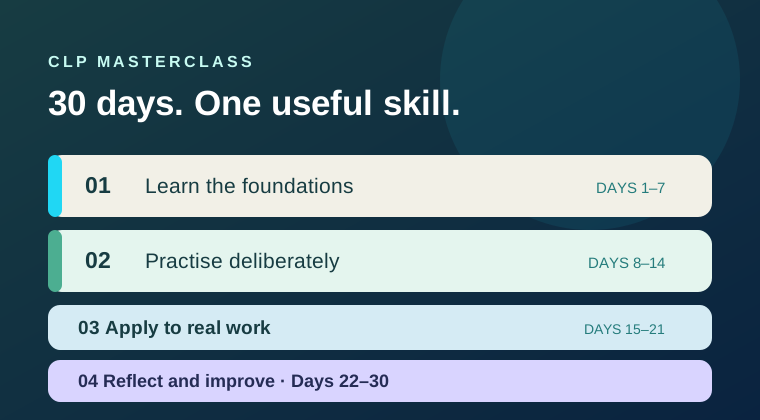
Week 1 — Understand the foundations (Days 1–7)
- Day 1: Write your learning goal and baseline.
- Day 2: Learn what generative AI can and cannot do.
- Day 3: Practise giving context, a task, constraints, and a desired format.
- Day 4: Compare a vague prompt with a specific prompt.
- Day 5: Ask for alternatives and evaluate the trade-offs.
- Day 6: Verify key facts against reliable sources.
- Day 7: Write a short reflection: what surprised you and what remains unclear?
Week 2 — Practise deliberately (Days 8–14)
- Use a consistent prompt structure: role or context, task, input, constraints, and output format.
- Break a complex request into smaller steps and review each result.
- Ask the model to state assumptions and identify missing information.
- Try one iteration cycle: draft, critique, revise, verify.
- Keep a small prompt journal with examples that worked and failed.
- At the end of the week, select one technique you can repeat reliably.
Week 3 — Apply AI to one real task (Days 15–21)
Choose a task with clear boundaries. Map its current steps, decide where AI assistance is useful, and retain human review for important decisions.
- Days 15–16: document the current workflow and define success criteria.
- Days 17–18: test an AI-assisted version on a small sample.
- Days 19–20: check quality, errors, time, and rework.
- Day 21: compare the assisted workflow with your baseline.
Week 4 — Improve and make it sustainable (Days 22–30)
- Days 22–24: improve instructions and add quality checks.
- Days 25–26: document a reusable workflow or checklist.
- Days 27–28: test it on a different example to see whether it generalises.
- Day 29: identify risks, privacy boundaries, and cases where AI should not be used.
- Day 30: review your baseline and choose the next learning goal.
Track progress without overcomplicating it
Use a simple weekly scorecard: practice sessions completed, output quality, time spent, errors caught, and confidence in verifying results. The goal is not to maximise AI use; it is to improve the task responsibly.
Common questions
Do I need a technical background?
No. Start with a task you understand. Technical depth can come later if it helps your goal.
What if I miss a day?
Continue the next day. Consistency matters more than an unbroken streak; repeat a session if you need more practice.
How do I know the plan worked?
Compare the final workflow with your baseline using quality, time, errors, and usefulness—not just how impressive the AI response looked.