
CLP DECODES · AI MADE PRACTICAL
AI Agents: Chatbot Se Aage Kya?
A chatbot usually responds to a prompt. An agent-style system may work toward a goal across multiple steps, using tools and checking results within defined permissions. The important question is not whether something is called an agent, but what it can actually do—and how it is supervised.
Chatbot aur AI agent mein kya difference hai?
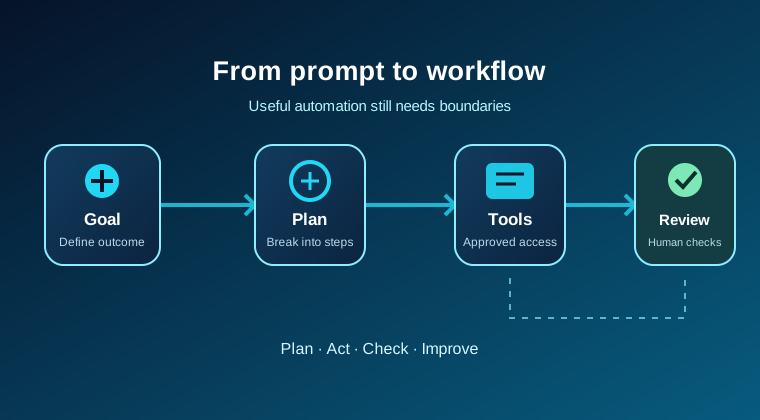
A typical chatbot interaction is conversational: you ask a question, and the model produces a response. An agent-style workflow can add a loop: interpret a goal, break it into steps, use approved tools, inspect the results, and decide what to do next. Products vary, and many combine both patterns.
- Chatbot pattern: explain a concept, draft a message, or answer a question from the information provided.
- Agent-style pattern: gather information from permitted sources, organise it, draft a result, check it against criteria, and return it for review.
A practical example: preparing a research brief
- Define the goal: prepare a short brief on a topic for a specific audience.
- Gather sources: use only approved search or document tools.
- Organise evidence: group findings by theme and retain source references.
- Draft and check: flag conflicting claims, missing evidence, and uncertainty.
- Human review: verify sources and approve the final brief before sharing.
This can reduce repetitive work, but it does not guarantee factual accuracy. A system may miss relevant sources, misunderstand instructions, or produce plausible but unsupported claims.
Where human oversight matters
Use limited permissions, clear success criteria, checkpoints, and an approval step before external or consequential actions. Avoid giving an experiment access to sensitive information or the ability to send messages, spend money, or change records without explicit controls.
Try a small, safe experiment
- Choose a repetitive, low-risk task.
- Write down the steps and the expected output.
- Identify which steps AI can assist with and what evidence must be checked.
- Run one trial and compare the result with your usual method.
- Record time saved, errors found, and what still required human judgement.
Key takeaway
AI agents are best understood as workflows that may plan and act across steps using tools and permissions. Start small, measure the outcome, and keep a person accountable for checking important results.
Common questions
Are AI agents always autonomous?
No. Autonomy varies by product, configuration, available tools, and permissions. Some systems ask for approval at each important step.
Can an AI agent make mistakes?
Yes. It can misunderstand goals, use weak evidence, or misjudge whether a task is complete. Verification and bounded permissions are essential.
What is a good first use case?
Try a repeatable, low-risk task such as organising public research or summarising non-sensitive notes, with source checks before relying on the result.